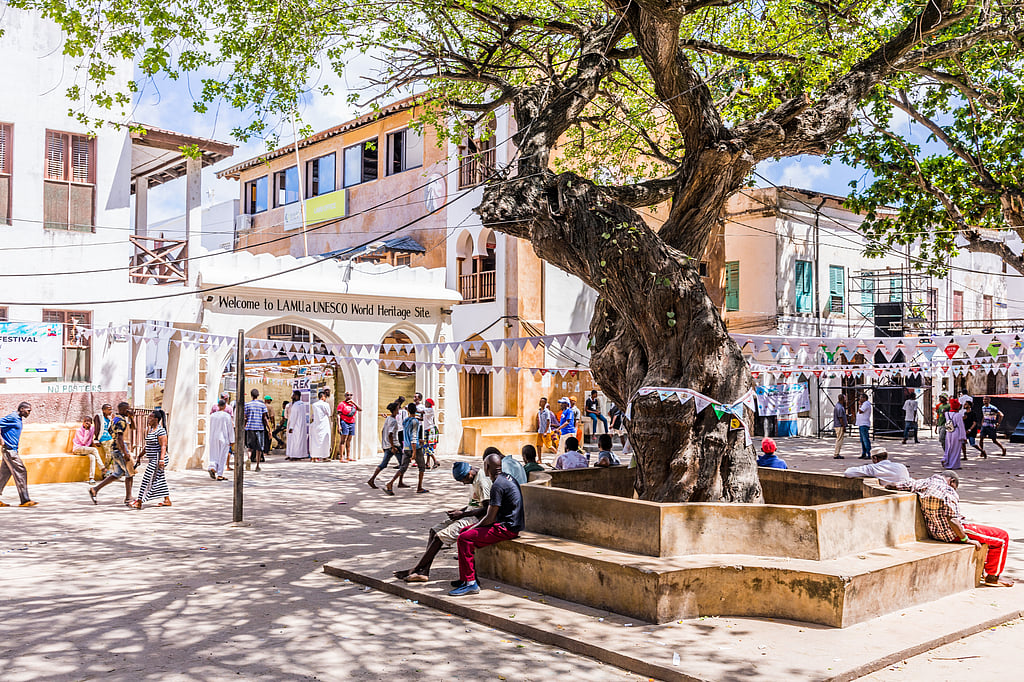
Discover A UNESCO World Heritage Site
Lamu Old Town was inscribed as a UNESCO World Heritage Site in 2001. It is the oldest and best-preserved Swahili settlement in East Africa, retaining much of its traditional character and functions. Constructed from coral stone and mangrove timber, the town is distinguished by the elegant simplicity of its structures, enriched with inner courtyards, verandas, and elaborately carved wooden doors. Since the 19th century, Lamu in Kenya has hosted major Muslim religious festivals and has grown into an important centre for the study of Islamic and Swahili cultures.
According to UNESCO, Lamu has “Outstanding Universal Value” as the oldest and best-preserved example of a Swahili settlement in East Africa. “With a core comprising a collection of buildings on 16 hectares, Lamu has maintained its social and cultural integrity, as well as retaining its authentic building fabric up to the present day,” says UNESCO.
Once the most important trade centre in East Africa, Lamu exerted significant influence across the region in religious, cultural, and technological spheres. A conservative and close-knit society, it has retained its status as an important centre for education in Islamic and Swahili culture, as reflected in the annual Maulidi and other cultural festivals. Unlike other Swahili settlements along the East African coast, which have been abandoned, Lamu has been continuously inhabited for over 700 years.


Lamu Island is famously car-free, with over 3,000 donkeys serving as the primary mode of transport, taxis, and cargo haulers through its narrow, ancient streets. This pedestrian-friendly, slow-paced lifestyle is central to the island’s distinctive Swahili culture. Transportation is limited to donkeys, walking, or dhow boats, preserving the quiet, winding lanes.
The narrow lanes in Lamu Old Town, Kenya
